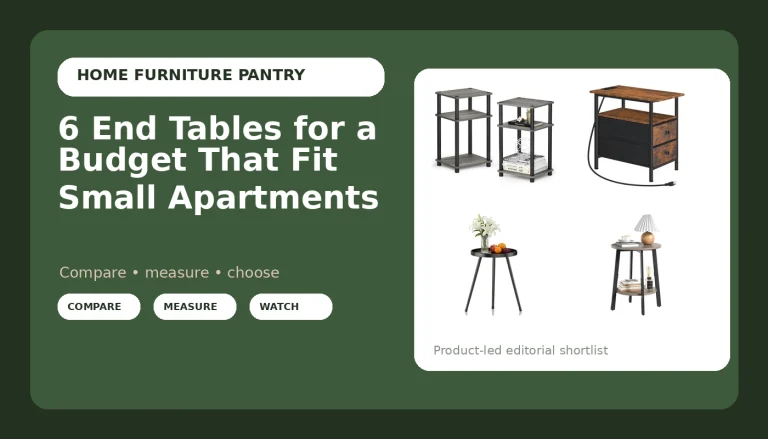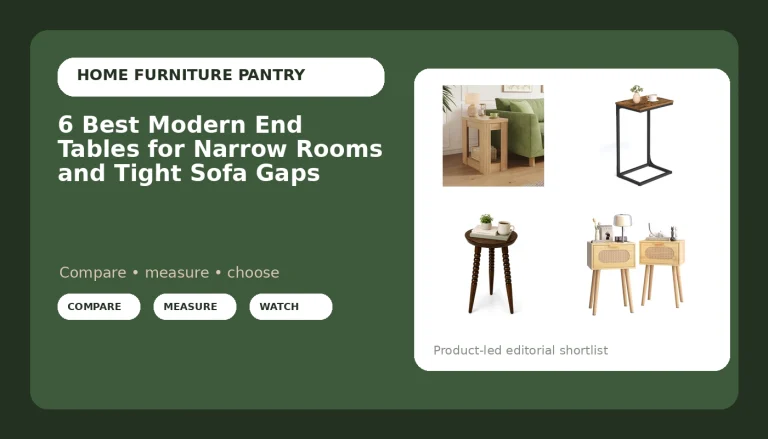
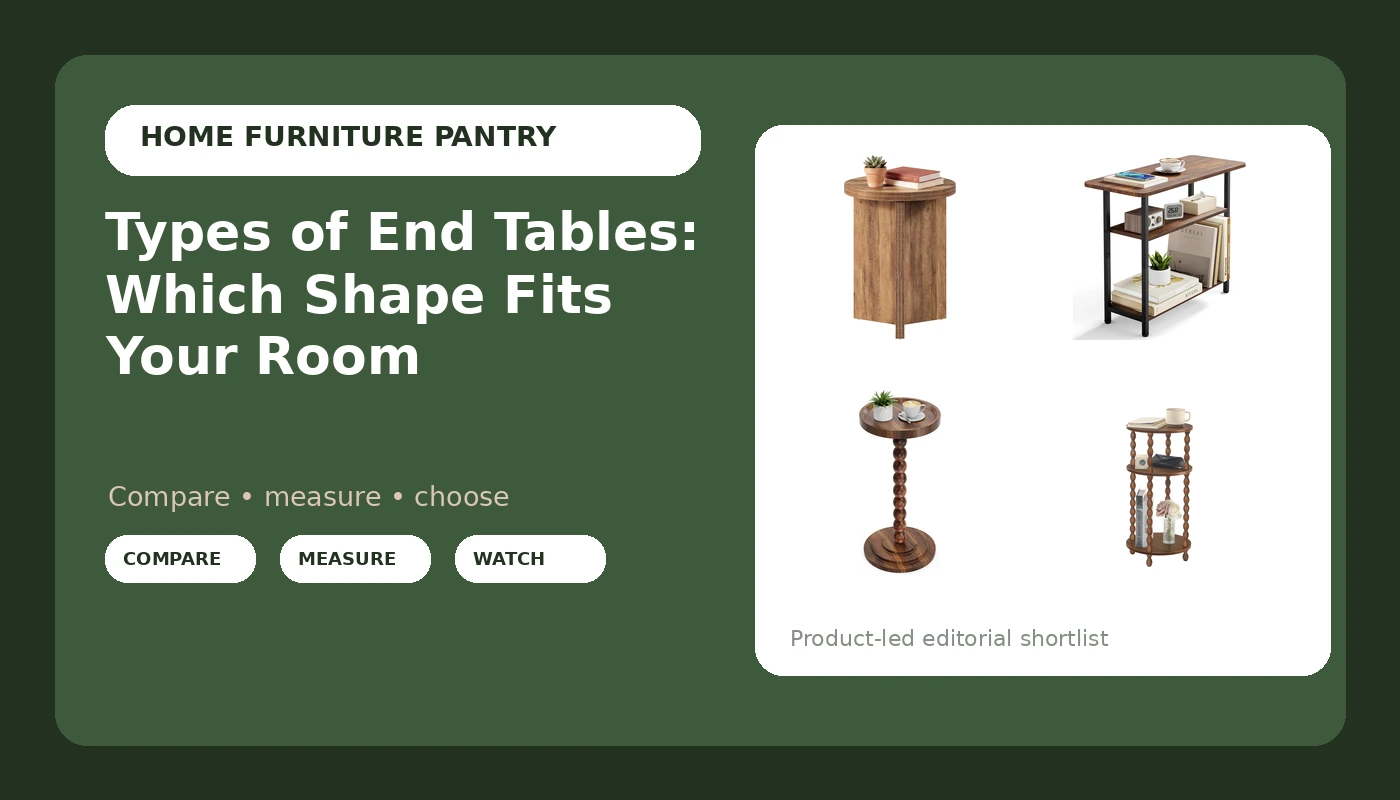
An end table is the smallest surface in a living room and the one you touch most: the mug, the remote, the phone, the lamp switch you reach for without looking. Because it is small, it is also the piece most often bought on looks alone and then returned because it blocked a walkway or sat below the sofa arm. The main types of end tables get easier to sort once you stop shopping by photo and start shopping by job, whether that job is holding a drink, holding a lamp, holding a stack of books, or simply filling a narrow gap without crowding the room. What follows is a plain breakdown of the shapes and structures you will actually find, five current options matched to the jobs they do best, and the measurements worth taking before you order anything.
Quick answer
The main types of end tables are round, square or rectangular, tiered shelf tables, pedestal or drink tables, and narrow console styles that slide into a gap. Shape decides how people move past the sofa, tier count decides how much you can store, and footprint decides whether the piece fits at all. Before ordering, measure the gap between the sofa arm and the wall, the height of the sofa arm, and the width of the walkway you want to keep clear. A list of top rated end tables is a starting point rather than a verdict, because the right type depends on your room, not on a ranking.
5 useful options
All five tables below are small-footprint pieces, but they solve different problems. None of them substitutes for a full coffee table, and each description sticks to what the listing itself states.
| Model | Best fit | What stands out |
|---|---|---|
| VASAGLE Round Side Table, Nightsand, Small End Table with Y-Shaped Base | A round top beside a sofa or reading chair | Round top carried on a Y-shaped base |
| SLEEPING LAMB Side Table for Living Room, 3-Tier End Table for Small Space with Wide Storage Tabletop | A narrow gap that still needs storage | Three tiers plus a wide storage tabletop in rustic brown |
| Round Wood Side Table & Drink Table with Sturdy Solid Wood Pillars | Drinks and a lamp in a tight corner | Solid wood pillars under a compact round top |
| AWASEN Small Round End Table, Round Side Table with 3-Tier Open Shelf for Small Spaces | A small room that needs open shelf storage | Three open shelves on a round walnut-brown frame |
| Round Side Table, Rubberwood Drink Table for Small Spaces, Solid Wood Pedestal Coffee Tables | Corners where a single small surface is enough | Rubberwood pedestal base with a 12.6 inch top |
The round standard: VASAGLE Round Side Table, Nightsand, Small End Table with Y-Shaped Base
A round top is the most forgiving shape in a walkway, because there is no corner at hip height to catch on a bag or a knee. The Y-shaped base is the detail worth noticing here: three legs that splay outward behave differently from a single pedestal when the floor is not perfectly level, and they also change where your feet can go underneath. The trade-off is that a round top cannot be pushed flush into a corner the way a square one can, so a few inches of floor space go unused behind it. If the table will sit in open space beside a sofa, that costs you nothing. If it has to tuck into an alcove, a square or rectangular top will use the same gap more efficiently.
The narrow-gap pick: SLEEPING LAMB Side Table for Living Room, 3-Tier End Table for Small Space with Wide Storage Tabletop
This is the type to look at when the gap beside the sofa is narrow but the storage problem is real. Three tiers give you somewhere to put the things that otherwise migrate to the floor: a basket, a stack of magazines, a tablet, a pair of glasses. The wide top relative to the frame is the useful part, because it means the surface you actually use is not sacrificed to the narrow footprint. The trade-off is twofold. Open tiers collect dust and are visible from every angle, so they reward tidiness more than a closed drawer would. And tiers reduce the open space under the top, which matters if you like to tuck your feet back under the table while sitting.
The drink table: Round Wood Side Table & Drink Table with Sturdy Solid Wood Pillars
A drink table is a deliberate downgrade in surface area in exchange for being easy to move and easy to live around. The solid wood pillars are the part that separates it from the flat-pack crowd, because pillar construction is a different assembly and a different look than a panel-sided box. What you give up is capacity: this is a table for one drink and one phone, not for a lamp, a book stack and a plant at the same time. That is fine if it lives next to a reading chair and gets moved when guests arrive. It is the wrong choice if you were hoping to clear the coffee table onto it.
The shelf tower: AWASEN Small Round End Table, Round Side Table with 3-Tier Open Shelf for Small Spaces
This one combines the two ideas above: the traffic-friendly round footprint with the storage of a tiered table. In a small room it can serve as a nightstand, a sofa-side table, or a printer stand in a home office, which is why the listing names all three. The trade-off is depth. Shelves on a round frame are always shallower at the edges than at the centre, so tall or wide items do not sit as securely as they would on a rectangular shelf. Use the tiers for books, baskets and boxes rather than for anything top-heavy, and check the shelf spacing in the listing photos against whatever you plan to store.
The pedestal: Round Side Table, Rubberwood Drink Table for Small Spaces, Solid Wood Pedestal Coffee Tables
A pedestal table is the cleanest silhouette of the group: one column, one top, nothing else. That makes it the easiest type to place in a corner where two walls meet, because there are no splayed legs or shelf edges to fight the skirting board. Rubberwood is a dense, commonly used furniture timber, and the listing names it directly rather than hiding behind a vague wood claim, which is worth noting if you have been burned by a veneer described as solid wood. The trade-off is stability geometry. A single pedestal concentrates the load on one small floor contact area, so it is a table for a lamp and a drink, not for leaning on. The 12.6 inch top is genuinely compact, so measure your lamp base before assuming it fits.
Prices and availability may change. Product images, names, and retailer links must be matched by verified ASIN. Do not state a current price, rating, stock status, or measured result without current evidence.
The main types of end tables and what each one does
Strip away the finishes and most end tables fall into five structural types. The round table is the traffic-friendly one: no corners, no sharp edges at knee height, and it reads as visually lighter in a small room. The square or rectangular table is the space-efficient one, because it can sit flush against a wall or sofa arm and use every inch of a gap. The tiered table adds storage at the cost of open legroom and a little visual weight. The pedestal or drink table is the minimal one, a single column and a small top for a glass or a lamp. The narrow console style is the corridor type, tall and thin, built for the sliver between a sofa and a doorway.
Two more variants are worth knowing even though they are not in the list above. The C-shaped table has a base that slides under the sofa seat, which puts the top over your lap; it is excellent for laptops and terrible for lamps, because the whole thing moves. The nesting table is a set of two or three that store under one another and come out when guests arrive, which suits rooms that are usually quiet and occasionally crowded.
This is where end tables reviews earn their keep. A review that says a table wobbled tells you about the joint or the base, which is the part that fails first. A review that says it looked bigger in the photo tells you the listing dimensions were read as interior space rather than exterior footprint. Read for the repeated complaint rather than the star average, and treat end tables for beginners as a category that rewards measuring over browsing.
How to choose end tables for your room
Think of this as the short end tables buying guide: four measurements and one honest question about what the table is for. Work through it in order and most of the wrong options eliminate themselves before you reach the checkout.
- Measure the gap. Take the distance from the sofa arm to the nearest wall or doorway, then subtract two inches so the table does not look wedged in.
- Measure the sofa arm height. A table top that sits roughly level with the arm looks intentional; one that sits well above or below it looks like an afterthought.
- Measure the walkway you want to keep. If people cut through the room, a round or pedestal table protects the path better than a rectangular one with corners.
- Decide the primary job. Lamp, drink, storage, or laptop. A tiered table for a laptop is wrong, and a drink table for a lamp is worse.
- Check the base, not just the top. Splayed legs, a Y-shaped base, and a single pedestal all need different amounts of floor space and all behave differently on carpet.
End tables size guide: the numbers to check
- Top diameter or width: enough for the lamp base or the tray you plan to put on it, plus a margin.
- Height against the sofa arm: level or slightly lower reads best in most rooms.
- Base footprint: the floor area the legs or pedestal actually occupy, which is always larger than the top on a splayed design.
- Shelf clearance on tiered tables: the gap between tiers, which decides whether a book or basket fits.
- Delivery dimensions: the box size and assembled width, because a small table can still arrive in a long flat pack that has to clear a stairwell turn.
An end tables comparison usually stops at the top surface and the finish. The two numbers that decide whether you keep the piece are the base footprint and the height against the sofa arm. Everything else is preference.
Which option should you choose?
Choose the VASAGLE Round Side Table, Nightsand, Small End Table with Y-Shaped Base when you want a round top in open space and the Y-shaped base suits the spot. Choose the SLEEPING LAMB Side Table for Living Room, 3-Tier End Table for Small Space with Wide Storage Tabletop when the gap is narrow but you need three tiers of storage and a wide working top. Choose the Round Wood Side Table & Drink Table with Sturdy Solid Wood Pillars when the job is drinks and a small lamp beside a chair. Choose the AWASEN Small Round End Table, Round Side Table with 3-Tier Open Shelf for Small Spaces when a round footprint and open shelves both matter, in a bedroom or a small living room. Choose the Round Side Table, Rubberwood Drink Table for Small Spaces, Solid Wood Pedestal Coffee Tables when a corner needs one clean column and a 12.6 inch top is enough.
The caveat is the same for all five: the listings describe shape, material and tier count, not load capacity, finish durability or assembly time. Those are the details to confirm in the current listing and in recent reviews before you commit. The best budget end tables are the ones whose base and height fit your room, not the ones with the lowest number on the page.
The bottom line
The types of end tables that matter are fewer than the listings suggest: round, square, tiered, pedestal, and narrow console, with C-shaped and nesting variants for specific jobs. Pick the shape by the walkway, pick the height by the sofa arm, and pick the tier count by what you actually need to put down. All five tables here are small-footprint pieces in the same general band, and the differences between them are structural rather than decorative. Measure the gap and the arm height first, then choose the structure that matches, and the table will still fit the room after the novelty of the finish wears off.