
Waterproofing a porch swing is two jobs wearing one name, and splitting them is the whole trick. The surface needs a finish that sheds water, and the seat needs a cover for the twenty-two hours a day nobody is sitting in it. That is the short answer to how to waterproof porch swings, and nearly every swing I have watched go bad outdoors got one half of the job and not the other.
I have moved six times in nine years, and four of those porches came with a swing somebody else had hung. The one off Manor Road had a chain that wept orange streaks onto the deck boards by its second summer. The wood swing on my current porch has taught me that water does not attack a swing evenly. It finds the end grain, the screw holes, the gap where the chain meets the eye bolt, and the low corner of the seat where it stands, and it works those spots until they give.
So this is the order I do the work in: identify the surface, seal it, protect the hardware, then cover the swing properly instead of throwing a tarp over it and calling that waterproofing. None of the products below have been hung on my porch, and I say that again further down. What follows is what the listings actually state and what water does to furniture once a finish quits.
Why you should trust me
I am not a finisher or a coatings chemist. I am the friend who gets the text when a listing photo turns out to be more optimistic than the box that arrived, and I have sealed, re-sealed, and eventually given away more porch swings than is reasonable for one renter's life. My notes app holds seat depths, chain lengths, and which finish came through an Austin summer, which is a specific kind of punishment for wood: weeks near a hundred degrees, then sideways rain, then a yellow coat of cedar pollen over everything.
What I know about water is what it does after a finish fails, not what the front of the can promises before it does. Nothing here was load tested by me and I have not hung the two swings below. What I did was read the listings line by line, note what the surface and the hardware actually are, and read the porch swings reviews that mention rust, mold, or a cover that quit shedding after a single season. That is the evidence I have, and I am not going to dress it up as more.
How I picked and how I tested
Read the heading as a challenge, because I am going to answer it honestly: I did not hang these three, and I did not leave them out in the rain to see what happened. What I did was treat each listing the way I treat an apartment listing, which is to assume the photos are the best case and the spec line is the truth.
Three things got checked. What the surface is: wood, a wicker weave, or a woven synthetic cover. What the hardware situation looks like, because a swing fails at the chain and the hooks before it fails at the frame. And whether the dimensions do the job they claim, which matters most on the cover. That listing gives 86 inches long, 45 wide, and a height written as a range from 32 down to 24 inches. The range is the useful part. It tells you the cover is cut to follow a sloped back rather than hang as a box, so the number you need to measure is the drop from the top of the back down to the low edge of the seat.
A porch swings size guide is really two size guides, one for the swing and one for the cover, and most people only do the first. A porch swings comparison that stops at frame material misses the half of the job that lives in the cover. And a porch swings buying guide decides which swing you own; this page decides what shape it is in next October. If you are still choosing, start with how to choose patio furniture that survives a wet season and come back when the swing is hanging.
What you need to waterproof porch swings
You need three things: the surface, the finish, and the cover. The two swings below are the surfaces in this article, and the cover is the part that does the actual waterproofing between coats. Each block carries the live listing, so check current Amazon price there rather than trusting a number in a blog post.
The wooden swing: VINGLI 2026 Upgraded 5 FT Wooden Porch Swing, 880 LBS Heavy Duty, Rustic
The wooden swing
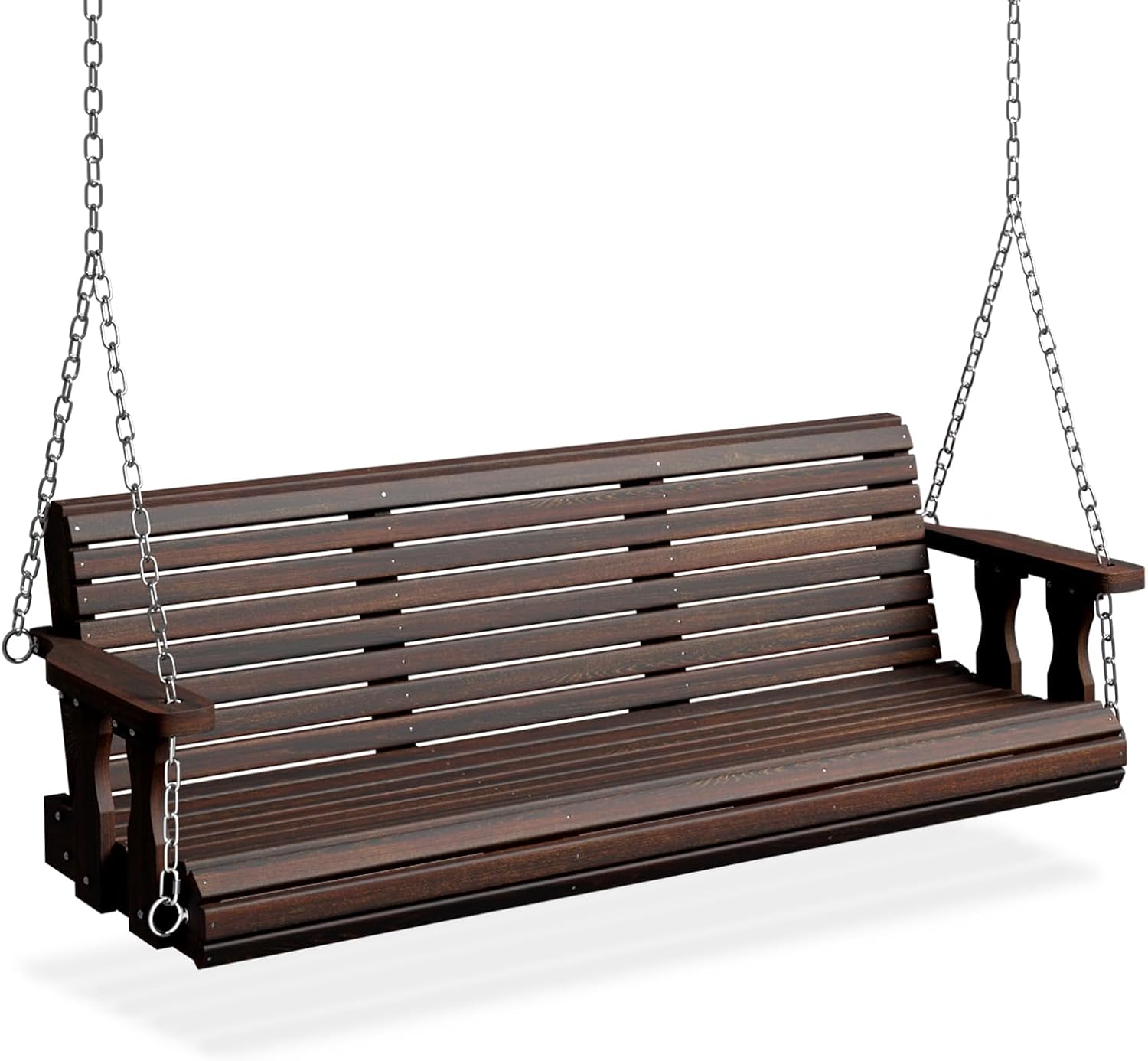
VINGLI 2026 Upgraded 5 FT Wooden Porch Swing, 880 LBS Heavy Duty, Rustic
Check current Amazon price.
Wood is the surface this article is really about, because wood is the one that visibly greys, checks, and splits if you skip the sealing step. The listing calls it a 5 FT wooden porch swing, which is sixty inches of seat, and it puts the number 880 pounds on it. Those are listing numbers and I am repeating them as listing numbers. What I can tell you is what five feet means on a porch: it is a two-person piece in most settings, and it wants a clear span wider than the swing itself, plus room for the chain to angle out at the top.
The word rustic in the name is a finish description, which is exactly the kind of word to verify against the photos and the buyer photos before you plan a sealing weekend. A rough surface drinks more finish than a sanded one, and that changes how much you buy. If the wood arrives with a factory coat on it, do the water drop test in step four before you buy anything, because a penetrating oil over a film finish is money in the trash.
Flaws but not dealbreakers: a wooden swing outdoors is a maintenance object, not a one-time purchase. If you want to hang something and forget it, the wicker one below or a cover used every week of the year is the more honest plan.
Anyone hanging a swing under a roof overhang, where rain only blows in from one side, gets the best result from wood, because you can re-oil the exposed end and leave the sheltered end alone.
The wicker swing: 3 Seat Hanging Wicker Porch Swing with Cup Holders, 800Lbs
The wicker swing
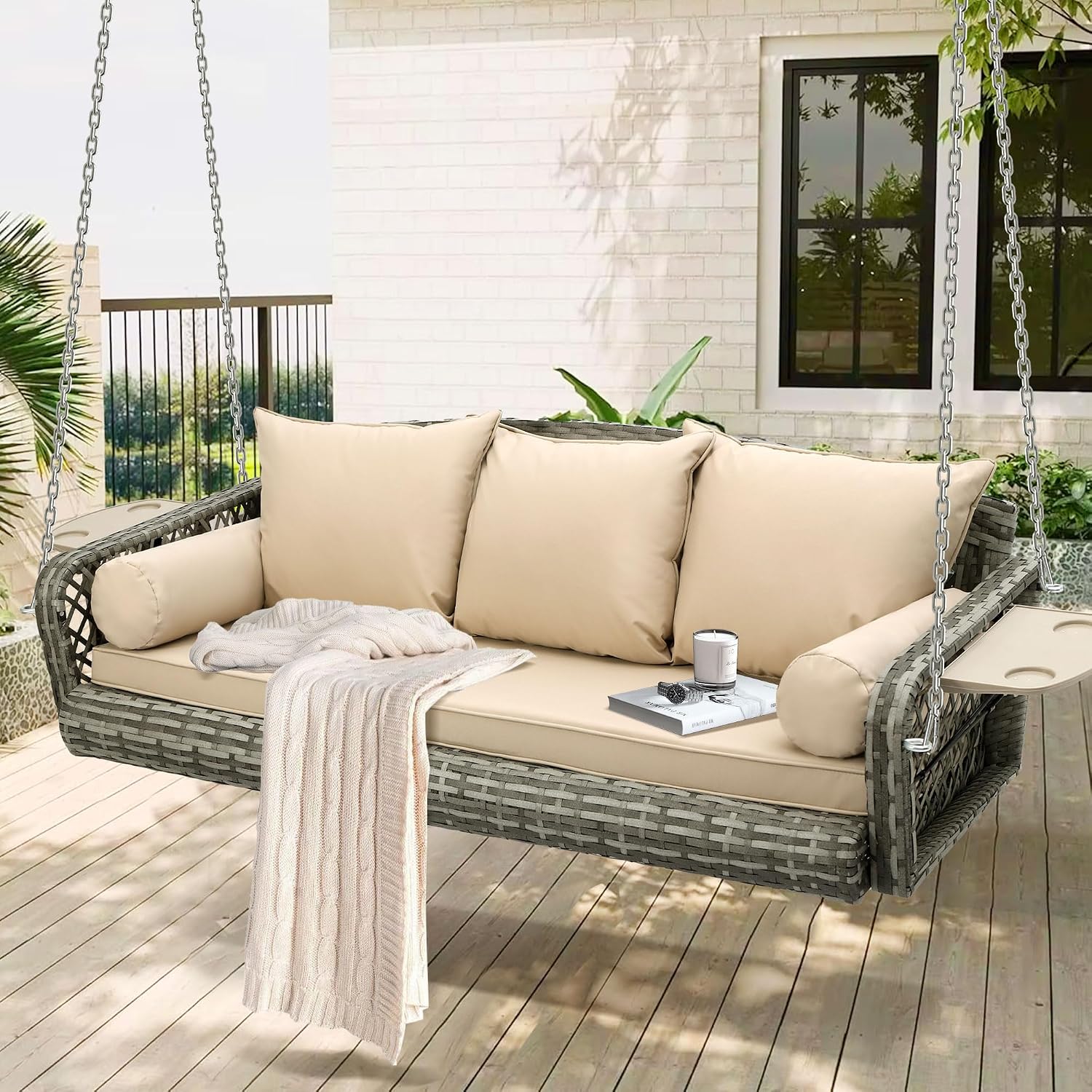
3 Seat Hanging Wicker Porch Swing with Cup Holders, 800Lbs
Check current Amazon price.
Wicker is the harder surface to keep dry, and the listing here does not describe the frame under the weave, so treat that as an open question until you read the photos and the buyer notes. What the listing does state is three seats, cup holders, and 800 pounds. The cup holders are the detail that matters for this job, because a cup holder is a well. It holds a quarter inch of rainwater long after the rest of the seat has dried, and that is where the mildew starts.
You cannot sand a weave the way you sand a board. The strands have gaps between them, water gets into the gaps, and a film finish over the top traps it there. That is why the cover matters more on this swing than on the wooden one, and why the cleaning step below is the whole waterproofing strategy for wicker rather than the prep for something else.
Flaws but not dealbreakers: a weave holds pollen and leaf grit in a way flat wood does not, so budget a soft brush and a hose, not a rag.
Anyone who wants a swing that is ready to sit in and does not want to own a sander should start here.
The cover that does the work: Porch Swing Cover 86 Inch Waterproof 600D Oxford Hanging Outdoor Swing Cover All Weather Protected Swing Covers for Outdoor Furniture (Black, 86x45x(32-24) Inch)
The cover that does the work
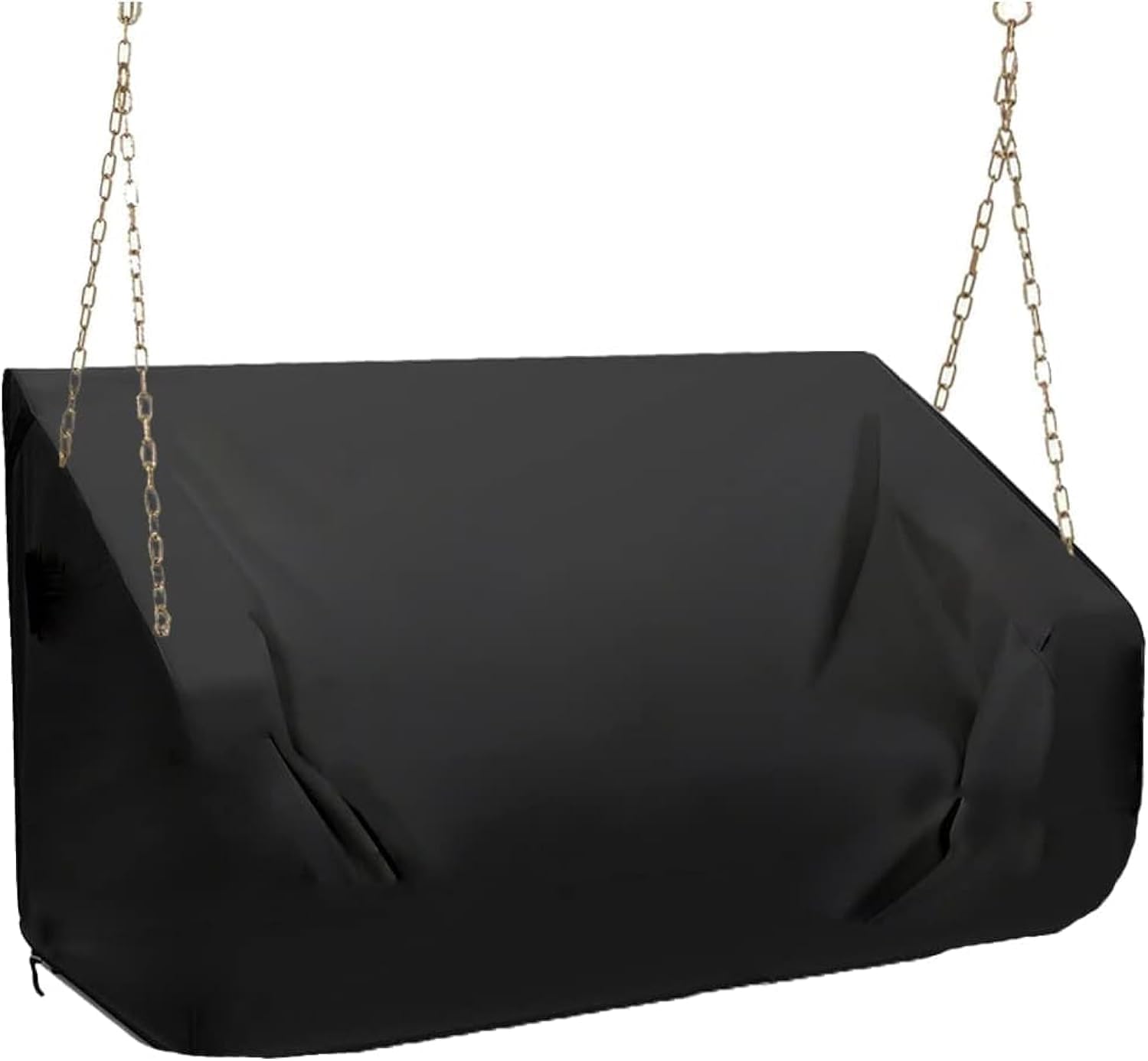
Porch Swing Cover 86 Inch Waterproof 600D Oxford Hanging Outdoor Swing Cover All Weather Protected Swing Covers for Outdoor Furniture (Black, 86x45x(32-24) Inch)
Check current Amazon price.
This is the piece that does the waterproofing on the days you are not out there with a brush. The listing names 600D Oxford, and denier is a yarn weight, with 600 in the heavier range for a furniture cover. It also claims waterproof and all weather protected, which are the listing's words, not a lab result I ran. What I can tell you is what to check before you buy: whether the seams are taped or bound, whether there is a hem or drawstring to pull it tight, and whether anything vents the top so condensation can leave.
The dimensions are the reason I would start here rather than with a generic tarp. Eighty-six inches long and 45 wide will swallow a five foot swing with room at each end, and the 32 to 24 inch height range is cut for a sloped back. Measure your drop before you order. A cover that is too tall hangs slack, and a slack cover pools water in the seat, which is worse than no cover at all because now the water sits instead of running off.
Black is the right color for something that lives outside. It hides pollen and the first faint mildew bloom that a beige cover wears like a badge.
Flaws but not dealbreakers: a fabric cover is a wear item. Sun eats the coating on any of them, and the honest expectation is that you replace it eventually, not that it outlives the swing.
Anyone with a swing on an exposed porch, or under a tree that drops something every month, should own one of these before they own a second swing.
How to waterproof porch swings, step by step
Here is the order, and the order is the part people get wrong. Porch swings for beginners get sealed before they get cleaned, which traps grit under the finish and gives you a coat that fails from underneath. Work top to bottom, and do not skip the hardware just because it is not made of wood.
Step one: Name the surface and find where the water sits. Walk around the swing with a flashlight after a rain. Look at the end grain at the arm ends, the screw heads, the low corner of the seat, and the chain connection. Those four spots are where every swing I have owned started to go, and they are the four spots you are going to spend your effort on.
Step two: Wash it and give it two dry days. Mild soap, water, a soft brush on a weave and a stiffer one on wood. Rinse, then leave it alone. Sealing over damp wood traps the moisture you are trying to keep out, and no finish on a shelf can fix that. Two clear days is the minimum I would trust, and more is better in humidity.
Step three: Sand the grey off before anything goes on. Grey wood is weathered wood, and finish does not bond to it. Hit the flat surfaces with 120 grit, follow with 220, and sand with the grain. On a wicker swing, skip the sanding entirely and use a soft brush plus a vacuum nozzle, because sandpaper shreds a weave.
Step four: Do the water drop test before you buy finish. Put a few drops of water on a flat, inconspicuous spot. If they stand and bead, there is still a finish there and you are recoating. If they soak in within a minute, you are starting from bare wood. That single test decides whether you need a light recoat or a full sand and seal, and it saves you from buying the wrong product.
Step five: Seal the wood, and do the end grain twice. A penetrating oil soaks in and leaves the grain able to breathe. A film finish sits on top and lasts longer in sun but cracks when the wood moves. Whichever you pick, read the recoat interval on the can and believe the back of the can, not the promise on the front. End grain drinks finish like a straw, so it gets two coats while the flats get one.
Step six: Treat wicker as a weave, not a board. Clean it, dry it, and leave it breathable. A film finish over a weave cracks in the gaps and then flakes off in chips that are miserable to remove. If you want extra protection on wicker, the cover is your answer, not another coat of something.
Step seven: Deal with the chain, the hooks, and the eye bolts. This is the step everyone skips. Look for orange staining at the top of the chain, feel for roughness on the hooks, and check that the spring or the hanger has not stretched. Replace rusting hardware rather than painting over it, because paint hides the failure and does not stop it.
Step eight: Fit the cover so it sheds, and reset everything each season. Pull it tight, make sure the low point is off the swing rather than over the seat, and take it off on a dry breezy day once a month so the wood can air. Once a season, run the water drop test again, wash the cover, and put the cushion somewhere dry. That routine is the difference between a cover that lasts and a cover that becomes a wet sack.
The competition and why it lost
The blue tarp lost first. It is cheap, it is waterproof in the sense that a plastic bag is waterproof, and it is the worst thing you can put on a swing for a season. It traps moisture underneath, it pools water in the low spot, and the grommets chafe the finish where it rubs. A tarp does not waterproof porch swings, it postpones the problem and adds a mildew smell for free.
The spray can sold for tents and shoes lost next. On the cover, a spray treatment is fine and extends the life of the fabric a little. On the wood or the wicker it is a surface treatment that sheds for a while and then needs redoing, and each reapplication sits on top of the last. It is a maintenance loop pretending to be a solution.
Polyurethane on a wicker swing lost badly. It looks great for one season, then it cracks in every gap in the weave and comes off in flakes. Wicker needs to breathe and to be covered, and a hard film fights both.
A cover bought on length alone lost too. Eighty-six inches long fits a five foot swing, but if the height does not match your drop, the cover hangs slack and collects water in the seat. Measure the drop, not just the length.
And the argument that a swing is rated for weather, so leave it out, loses every time. The top rated porch swings in any listing are rated on a showroom photo and a number in the title, not on a Tuesday in April with the wind coming sideways.
What this all costs
I am not going to print prices, because they move and a stale number is worse than no number at all. Every listing above carries the live figure, so check current Amazon price on whichever piece you are actually buying.
What the job costs comes in three buckets. First, the cover, which is the smallest outlay of the three pieces here and does the most work per dollar in a wet month. Second, the consumables: a sealer or a spar finish, a decent brush, 120 and 220 grit, mild soap, and replacement hooks if yours are rusting. That bucket is the one people forget, and it is the bucket that decides whether the swing survives. Third, the swing itself, if you are starting from nothing.
The arithmetic I actually run is cost per season, not cost per purchase. A cover replaced every few years and a swing re-oiled each spring is cheaper per year than replacing a swing every fifth year because the end grain opened up and nobody noticed. The drying is what takes the time; the work itself is a couple of hours, once, and then about an hour each spring. That hour is the whole difference between a swing that is still a swing in five years and a swing that has quietly become a planter.
Water is patient. Be more patient than the water.